



SAP S/4HANA Finance
Financial Accounting, Controlling, and group consolidation on a shared data foundation – the Universal Journal.







What is SAP S/4HANA Finance?
SAP S/4HANA Finance isn't an add-on product — it's the technical foundation of accounting in every S/4HANA system: the Universal Journal. In the ACDOCA table, postings from Financial Accounting (FI), Controlling (CO), Asset Accounting (AA), and Materials Management (MM) come together in a single line item with over 360 fields.
This eliminates the classic reconciliation between FI and CO – the financial and management views are based on the same data, in real time. S/4HANA's core finance applications build on this: Central Finance for group-wide consolidation landscapes, SAP Group Reporting for group close, and Advanced Financial Closing for orchestrating the close process itself.
Your Requirements
What companies need today
- A unified data foundation for finance and controlling views, without reconciliation effort
- Group-wide consolidation without migrating every source system up front
- Harmonizing heterogeneous SAP and non-SAP finance landscapes
- A structured, traceable period-end close instead of Excel checklists
- Parallel accounting under multiple standards (e.g. HGB and IFRS)
- Group-wide transparency into liquidity and cash flows
Our Solution
What SERKEM delivers
- Design and implementation of the Universal Journal / New General Ledger
- Central Finance architecture for phased consolidation of source systems
- Building SAP Group Reporting, including consolidation logic and reporting structure
- Migration to New Asset Accounting with the ledger concept
- Implementation of SAP Advanced Financial Closing for the close process
- Integration of SAP Cash Management for group-wide liquidity management
Capability Areas
SAP S/4HANA Finance at a Glance
Four building blocks form the backbone of digital accounting in S/4HANA.
Universal Journal (ACDOCA)
The Universal Journal table ACDOCA unites Financial Accounting, Controlling, Asset Accounting, and Materials Management in a single line item with over 360 fields.
- A unified view of FI, CO, AA, and MM without reconciliation postings
- Real-time posting at document and line-item level
- The data foundation for all Fiori analytical apps in finance
- Eliminates the classic FI/CO reconciliation at period-end
- Compatible historical totals records remain accessible
- The foundation for embedded analytics and AI capabilities
Central Finance
Central Finance replicates postings from SAP ECC and non-SAP source systems in real time into a central S/4HANA Finance instance — without migrating the operational systems themselves.
- A group-wide financial view without a big-bang migration
- Connecting heterogeneous ERP landscapes via SAP Landscape Transformation
- Phasing out source systems at your own pace
- Central harmonization of chart of accounts and master data
- Early value from S/4HANA Finance capabilities before full migration
- A foundation for group-wide reporting from a single source
SAP Group Reporting
SAP Group Reporting consolidates directly on Universal Journal data — actuals from ACDOCA and plan figures from ACDOCP come together in the shared ACDOCU table.
- Group consolidation without a separate consolidation tool
- Matrix consolidation across multiple dimensions at once
- A consolidation monitor with a full audit trail
- Intercompany reconciliation directly in the system
- Consolidated figures in near real time instead of at month-end
- A single data origin for actuals and plan values
SAP Advanced Financial Closing
Advanced Financial Closing orchestrates and monitors close tasks at the individual entity level — with templates, ownership, and a full audit trail.
- Task templates for recurring close steps
- Status tracking by task and owner
- Automated reminders when deadlines are missed
- Seamless handoff of results to SAP Group Reporting
- Audit-ready documentation of the entire close process
- Suited for both local and group-wide close cycles

Financial Reports Directly from the Universal Journal
Because all postings live in a shared table, Fiori's finance analytics apps access the current state without any separate data preparation.
- The "Balance Sheet/P&L" app for live evaluations per company code
- The "Display G/L Account Balances" app with drill-down to the individual line item
- Freely selectable time periods instead of fixed month-end snapshots
- Seamless switching between totals and document level
Strategic Outlook
SAP Group Reporting vs. Classic Consolidation
Many corporate groups still consolidate via SAP SEM-BCS or external tools – SAP Group Reporting moves this step into the S/4HANA core.
SAP SEM-BCS / External Consolidation
Consolidation as a separate process after the individual close, with its own data model and its own load process from accounting.
- A standalone system with a separate data model
- Delayed data reconciliation with the general ledger
- An additional load process before every consolidation round
Ideal when…
Consolidation already runs stably and no system change is planned in the near term.
SAP Group Reporting in the S/4HANA Core
Consolidation directly on Universal Journal data — no separate load process, with an end-to-end audit trail down to the individual document.
- Actual and plan data from the same data foundation (ACDOCU)
- A consolidation monitor with full traceability
- Shorter paths between the individual close and the group close
Ideal when…
A move from SAP ECC/SEM-BCS to S/4HANA is planned, or consolidation should be more tightly coupled to the operational close.
Architecture
From Document to Group Close
A single posting passes through five stages before it appears in the consolidated group report.
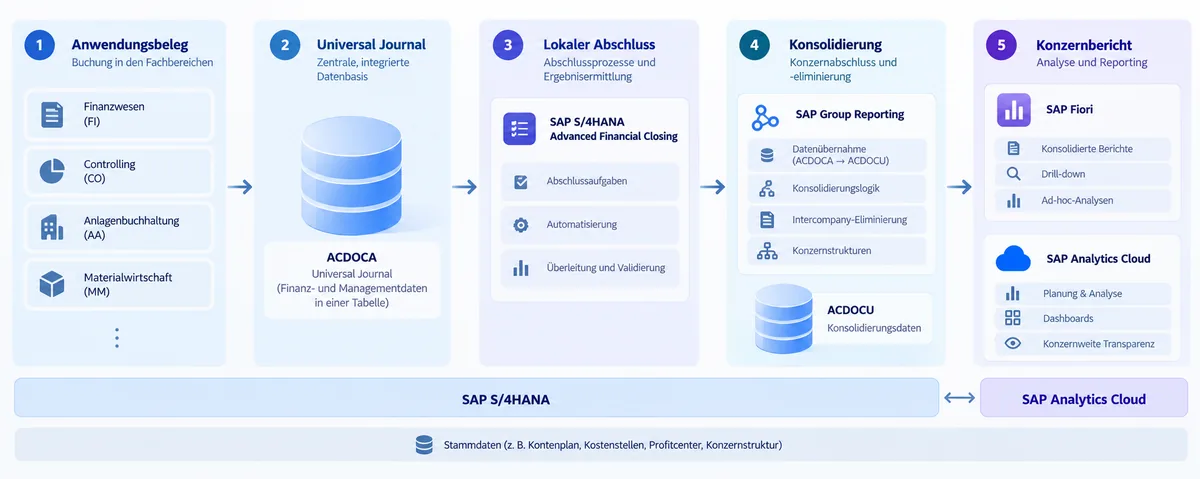
Click image to enlarge
News, real-world insights, and perspectives from our SAP experts. (German-language articles)

ViDA: Was die EU-Meldepflicht bis 2030 verlangt

E-Rechnung Frankreich 2026: sind Sie ab September bereit?

E-Rechnungspflicht: was bis 2028 auf Sie zukommt

ECC-Support endet 2027: das Fenster ist enger als gedacht

Fiori-Apps ohne Handarbeit: Fiori elements und RAP
Frequently Asked Questions
FAQ: SAP S/4HANA Finance
Answers to the most common questions about the Universal Journal, Central Finance, and Group Reporting.
In SAP ECC, Financial Accounting (tables BSEG/BKPF) and Controlling (including COEP) lived in separate tables that had to be kept in sync through periodic reconciliation postings. The Universal Journal brings both views together in a single table (ACDOCA) – every posting is simultaneously an FI and a CO document, so reconciliation is no longer needed.
No. Central Finance replicates financial postings from existing SAP ECC and non-SAP systems into a central S/4HANA instance, while the operational source systems keep running unchanged for now. This enables group-wide reporting before a full system migration is even on the table – the actual retirement of source systems can happen in phases.
Functionally, SAP Group Reporting covers the classic consolidation scope – matrix consolidation, intercompany reconciliation, a consolidation monitor. The key difference is architectural: instead of a separate system with its own data model, consolidation runs directly on Universal Journal data. Whether a replacement makes sense depends on the state of your existing consolidation landscape and your planned S/4HANA timeline.
New Asset Accounting posts asset values directly in the Universal Journal instead of in a separate subledger. The ledger concept lets you run multiple valuation approaches – such as HGB and IFRS – in parallel in the same system, each with its own ledger, without setting up redundant company codes.
Advanced Financial Closing orchestrates and monitors close tasks at the individual entity level – from valuation through reporting to the group. SAP Group Reporting builds on this released data and consolidates it into the group close. The two applications complement each other but can also be used independently.
Yes. The Universal Journal's ledger concept lets you represent multiple accounting standards – such as HGB, IFRS, or US-GAAP – in parallel within the same system. Each ledger applies its own valuation rules, without needing separate company codes or systems.
SAP Cash Management brings together liquidity planning, bank account management, and cash flow analysis on the same Universal Journal data as the rest of accounting. Actual and plan data from incoming payments, outgoing payments, and open items flow into the liquidity overview without a separate interface – group-wide cash transparency emerges as a by-product of the same data foundation, not as a standalone reporting process.
Ready to put your accounting on a shared data foundation?
SERKEM guides you from assessing your existing FI/CO landscape through the Central Finance architecture to productive SAP Group Reporting.