



Migrate from SAP PI/PO to the SAP Integration Suite
SAP PI/PO reaches end of mainstream maintenance in late 2027. Start planning now and you'll have time for a structured migration without time pressure – and gain a future-proof, fully managed platform with the Integration Suite.








Why migrate now?
SAP PI/PO has worked reliably for years – as on-premises middleware for SAP-to-SAP and SAP-to-non-SAP scenarios. With mainstream maintenance ending and SAP's strategic focus on cloud-native architectures, there's no sensible way around the SAP Integration Suite anymore.
Migration isn't a risk – it's an opportunity. Restructuring your integration landscape creates clearer architecture, better monitoring, and lower operating costs. SERKEM guides this step with a proven approach that documents, prioritizes, and transfers your inventory step by step.
Your starting point
What concerns companies before migrating
- A grown PI/PO landscape with 50 to over 300 scenarios – no complete inventory exists
- Unclear prioritization: which scenarios are business-critical, which are outdated?
- No in-house BTP experience – no know-how in iFlow development or the Integration Suite
- Concerns about business disruption during migration
- Unclear cost estimate: effort, licensing, and timeline are hard to pin down
- B2B/EDI mappings and complex Java mappings – concerns about the effort to rebuild them
Our approach
What SERKEM delivers
- A complete inventory of all PI/PO scenarios, including complexity assessment and migration effort
- A prioritized migration plan: critical scenarios first, outdated scenarios eliminated
- Parallel operation: PI/PO and the Integration Suite run simultaneously – no big-bang cutover
- Rebuild of every scenario as an iFlow – including complex mappings, B2B connections, and custom logic
- Knowledge transfer and training for your in-house team alongside the migration
- A clear effort and timeline estimate right after the analysis phase – no surprises along the way
Approach
The SERKEM migration path in 5 phases
Structured, low-risk, and transparent – from the initial inventory to decommissioning the PI/PO system.
Phase 01
Analysis & inventory
A complete record of every PI/PO scenario: adapters, mappings, communication channels, usage frequency, and technical complexity. The basis for every step that follows.
Phase 02
Migration concept
Prioritizing scenarios by criticality and effort. Defining migration waves, timeline, BTP architecture, and the operating concept for parallel operation.
Phase 03
iFlow development
Rebuilding PI/PO scenarios as iFlows in the Integration Suite, wave by wave. Mapping migration, adapter configuration, error handling, and unit tests per scenario.
Phase 04
Testing & parallel operation
Integration testing in parallel operation: PI/PO and the Integration Suite process the same messages. Results are compared, errors analyzed, and each wave signed off.
Phase 05
Cutover & PI/PO decommissioning
A controlled cutover per wave: the Integration Suite takes over production operation, PI/PO scenarios are deactivated. Step by step, until fully decommissioned.
Phase 1 — Analysis
Inventory: what's actually in the PI/PO system?
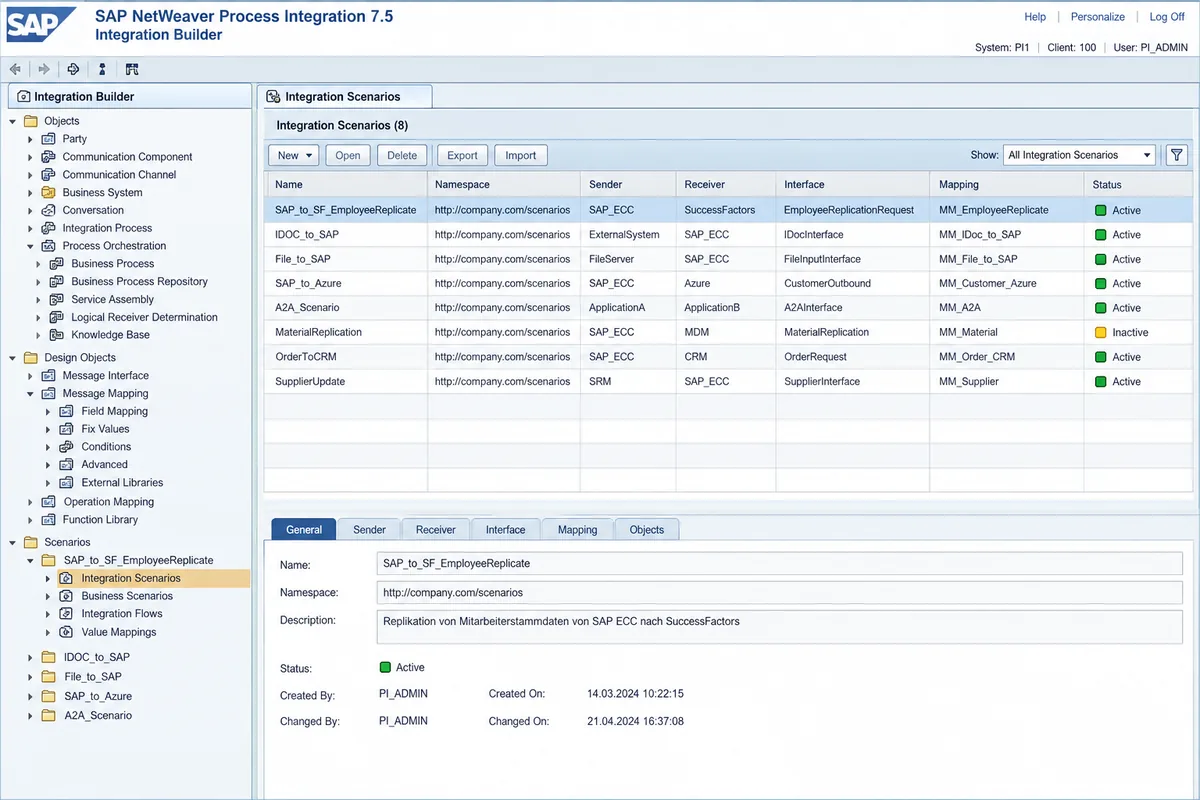
The most common mistake in PI/PO migrations is underestimating the inventory. Many systems contain scenarios that haven't been actively used in years – yet still exist in the system. SERKEM takes a structured, complete inventory and assesses every ICo (Integrated Configuration Object) by usage, complexity, and migration effort.
- ICo export & analysis: Export every Integrated Configuration Object from PI/PO and classify it by adapter type, mapping complexity, and communication partners
- Usage analysis: Evaluate message logs – which scenarios are actively used in production, which are inactive or outdated? Inactive scenarios aren't migrated, they're eliminated
- Mapping inventory: Record Java mappings, XSLT, and message mappings – assess the effort to rebuild them as iFlow logic
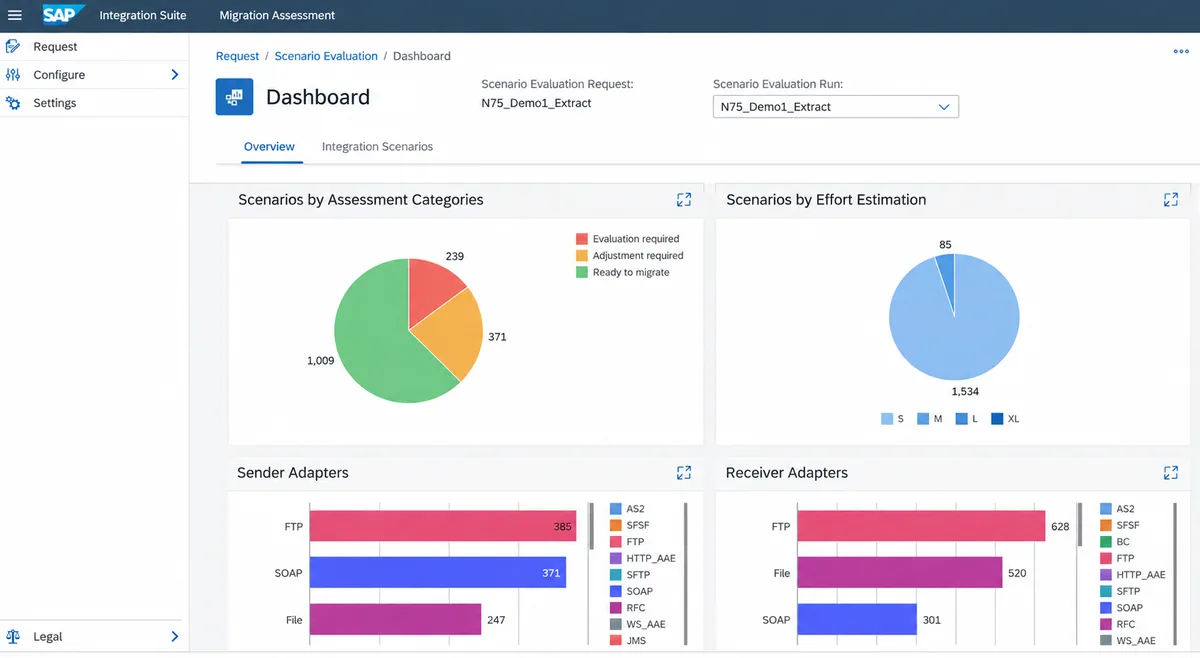
- Effort estimate: A story-point assessment per scenario – producing a total effort figure and a realistic basis for the timeline
Phase 3 — Development
iFlow development: precise rebuilding, not blind conversion
SAP offers an automatic conversion of PI/PO scenarios into iFlows via the Integration Suite's migration tool. It's a good starting point – but no substitute for experienced developers. SERKEM uses the tool to accelerate the work, but manually reviews and optimizes every migrated iFlow.
- Migration tool: SAP's official migration tool automatically converts ICos and mappings into iFlow artifacts – SERKEM reviews and cleans up every result
- Java mappings → Groovy: Java-based PI/PO mappings are converted into Groovy scripts and checked for Integration Suite compatibility
- Adapter equivalents: RFC/IDoc adapters from PI/PO are replaced with Integration Suite adapters – configuration parameters are fully carried over
- Error handling: PI/PO alert rules are rebuilt as alert configurations in the Integration Suite – the monitoring concept is designed in from the start
- Cloud Connector: On-premises systems are securely connected to the Integration Suite via the SAP Cloud Connector – with no inbound firewall openings
Phases 4 & 5 — Cutover
Parallel operation: safety through controlled cutover
No big-bang cutover – that's the core principle of SERKEM's migration strategy. PI/PO and the Integration Suite run in parallel for each wave until every test has passed. Only then is the PI/PO scenario deactivated. Risk to ongoing operations is controlled at every point in time.
- Wave migration: Scenarios are migrated in groups (waves) – typically by business unit or system connection. Each wave is signed off individually
- Message comparison: During parallel operation, PI/PO and Integration Suite outputs are compared – discrepancies are identified and fixed before the cutover
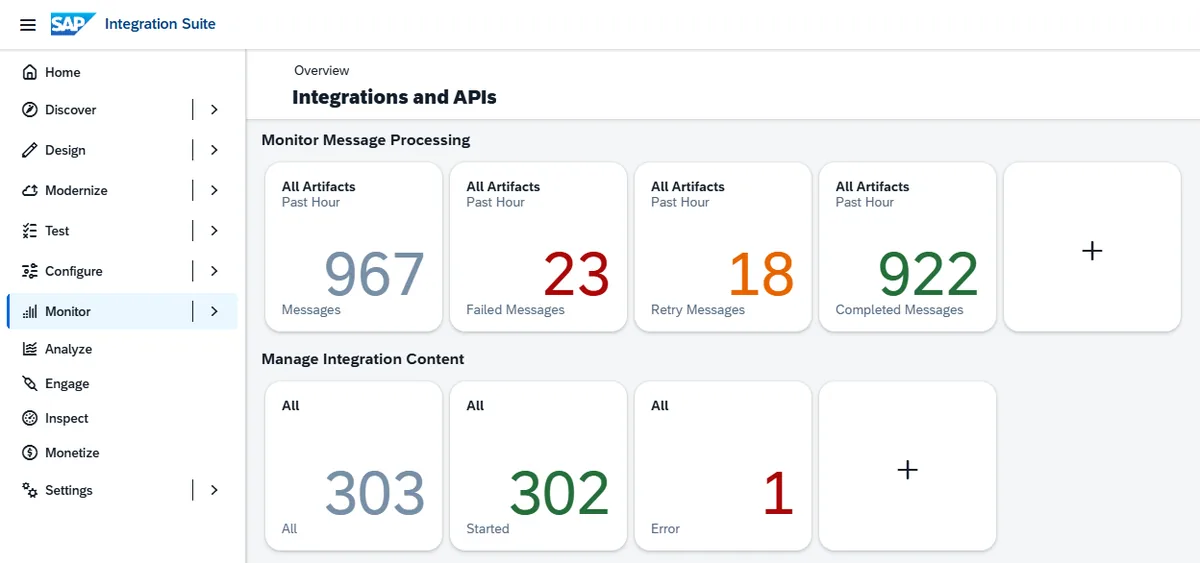
- Monitoring from day one: Integration Suite alert rules and the message monitor are configured before go-live – operations are visible from the very first day
- Rollback strategy: Every wave has a defined rollback plan back to PI/PO – right up to the final cutover of the entire landscape
- Hypercare: After each wave's go-live, SERKEM supports operations for a defined period and responds to any incidents
PI/PO vs. Integration Suite
What changes after the migration
A direct comparison of the most relevant characteristics – for decision-makers and technical teams alike.
| Characteristic | SAP PI/PO End of Maintenance 2027 | SAP Integration Suite Strategic Platform |
|---|---|---|
| Infrastructure | On-premises servers (your own hardware, operations, patching) | Fully managed on SAP BTP – no infrastructure of your own |
| Updates & maintenance | Manual support package installation by SAP Basis | Continuous updates from SAP, no upgrade projects |
| Scaling | Fixed server sizing, scaling requires hardware investment | Automatic scaling in the cloud, consumption-based |
| Monitoring | Message Monitor in SAP NWA, alert inbox, often hard to use | Unified monitoring cockpit, payload inspection in the browser |
| API management | Not included – a separate tool is required | Built in: API management, developer portal, rate limiting |
| B2B/EDI | Separately configured, EDI mapping done manually | Integration Advisor with AI-assisted mapping (MIG/MAG) |
| Third parties | Custom adapters, high development effort | 170+ ready-made connectors via Open Connectors |
| Licensing model | On-premises license + infrastructure costs | Subscription on SAP BTP (CPEA or capacity-based) |
News, real-world insights, and perspectives from our SAP experts. (German-language articles)
APIs im Griff: API-Management der Integration Suite
PI/PO läuft 2027 aus: der Weg zur Integration Suite
Build Work Zone: Launchpad ablösen — oder besser nicht?
Eine Datengrundlage für alles: SAP Business Data Cloud
Apps bauen, ohne den Kern zu berühren: SAP Build
Frequently asked questions
FAQ on the PI/PO migration
The most important questions about migrating from SAP PI/PO to the SAP Integration Suite – answered openly and directly.
No – and that's one of the biggest benefits of a careful analysis. Experience shows that 20–40% of configured scenarios in many PI/PO systems are inactive or outdated. These don't need to be migrated – they can be eliminated. That significantly reduces the migration effort and is a good opportunity to consolidate your integration landscape.
The Integration Suite's migration tool handles simple to medium scenarios well – particularly ICos with standard adapters and message mappings. It hits its limits with complex Java mappings, multi-mapping scenarios, or heavily customized adapter configurations. SERKEM uses the tool to accelerate every supported scenario, but manually reviews every generated iFlow and rebuilds complex scenarios from scratch.
That depends heavily on the size of the landscape:
- Small landscape (up to 30 scenarios): manageable effort
- Medium landscape (30–100 scenarios): significantly more coordination effort
- Large landscape (over 100 scenarios): a multi-stage wave migration approach is required
This applies to a structured wave migration including parallel operation and testing. Complex B2B/EDI scenarios or Java mappings add further effort. A reliable estimate is available after the analysis phase.
Java mappings from PI/PO don't run directly in the Integration Suite. They must either be converted into Groovy scripts or reimplemented as XSLT/message mapping. Simple Java mappings can often be ported to Groovy 1:1. Complex logic is re-analyzed and, if needed, split across several iFlow steps. SERKEM assesses the effort for each Java mapping individually during the analysis phase.
Technically, permanent parallel operation is possible, but strategically it's not advisable. Running two different integration middleware systems in parallel means double the administration effort, double the monitoring, and double the license costs. The goal of the migration is to fully replace PI/PO. Parallel operation is a means to migrate, not a permanent end state – and it's time-limited anyway, given the end of maintenance in 2027.
Migration costs consist of project costs (analysis, development, testing, cutover) and the ongoing Integration Suite subscription model on SAP BTP. In most cases, savings on infrastructure (no server of your own), Basis operations (no patching), and extended maintenance costs from 2028 onward will offset the migration costs in the medium term. As part of the analysis phase, SERKEM prepares a total-cost-of-ownership comparison for your specific situation.
Ready for the PI/PO migration?
We start with a structured inventory of your PI/PO landscape and deliver a reliable migration effort estimate – before the first iFlow is even built.