



SAP Joule Studio
When the standard skill catalog leaves a gap, we build it: custom Joule Skills in SAP Joule Studio, from intent and action to test simulation and the release process – connected to your CAP, RAP, or API services.








What Is SAP Joule Studio?
SAP Joule Studio is the development tool used to build custom skills for SAP Joule – for processes that no SAP standard skill covers. A skill consists of a recognized intent, an action that calls an interface or a CAP/RAP service, and a response that returns the result in an understandable way. Joule Studio brings the design, connection, and testing of these building blocks together in one place.
This page assumes that a specific skill gap has already been identified and prioritized – that groundwork is covered on the SAP Joule Skills page. Here, we focus on the technical implementation: from the first draft in Joule Studio to a tested, approved, and productively rolled-out custom skill.
Your Starting Point
What Slows Down Skill Development
- A skill gap has been prioritized, but no one on the team can implement it technically
- No defined build process for custom skills – every approach is a one-off
- Unclear governance over who is allowed to build and publish skills
- Skills go live directly without structured testing
- No versioning of skills between dev, test, and production environments
- Transactional skills with write access are handled without special care
What We Deliver
From Draft to Production-Ready Custom Skill
- Building a custom skill in Joule Studio from intent to action
- Connecting to CAP/RAP services or APIs for the actual functionality
- Test and simulation environment before the production rollout
- Governance process for approval and versioning across dev/test/prod
Key Concepts
The Anatomy of a Joule Skill
Five building blocks that make up every skill in Joule Studio.
Intent & Utterances
The intent a skill recognizes, along with example phrasings users typically use to express that intent.
Action
The actual call to a CAP or RAP service or an external API that executes the request.
Grounding & Context
The data sources and authorizations that ground and validate a response.
Response Template
The template used to translate an action's result into an understandable, consistent response.
Testing & Simulation
The simulated execution of a skill with example utterances before release for production use.
Our Approach
From Idea to Production Skill
Four clearly defined phases from requirements design to approved rollout.
Requirements & Design
Functional specification of the skill: intent, required data, target system, and authorization requirements.
Build in Joule Studio
Configuring intent, action, and response template, including connection to a CAP, RAP, or API backend.
Test & Simulation
Simulated execution with realistic sample requests, including checks of edge cases and error paths.
Approval & Rollout
Documented approval, versioning across dev/test/prod, and role-based activation in production.
Scope of Services
What We Build in Joule Studio
From skill definition to the approval process – the building blocks of a production-ready custom skill.
Skill Design (Intent & Utterances)
Defining the recognized intent along with representative example phrasings for reliable recognition.
Action Integration with CAP/RAP/APIs
Connecting the skill to existing CAP and RAP services or external APIs for the actual functionality.
Response Templating
Consistent, understandable response design – from simple information to feedback after an action.
Test & Simulation Environment
Simulated skill execution with sample requests before approval – including edge cases and error paths.
Versioning & ALM
Traceable version states of a skill across development, test, and production environments.
Approval Process & Governance
A defined approval path for who may review and release new or changed skills into production.
Skill Builder
From Intent to First Working Version
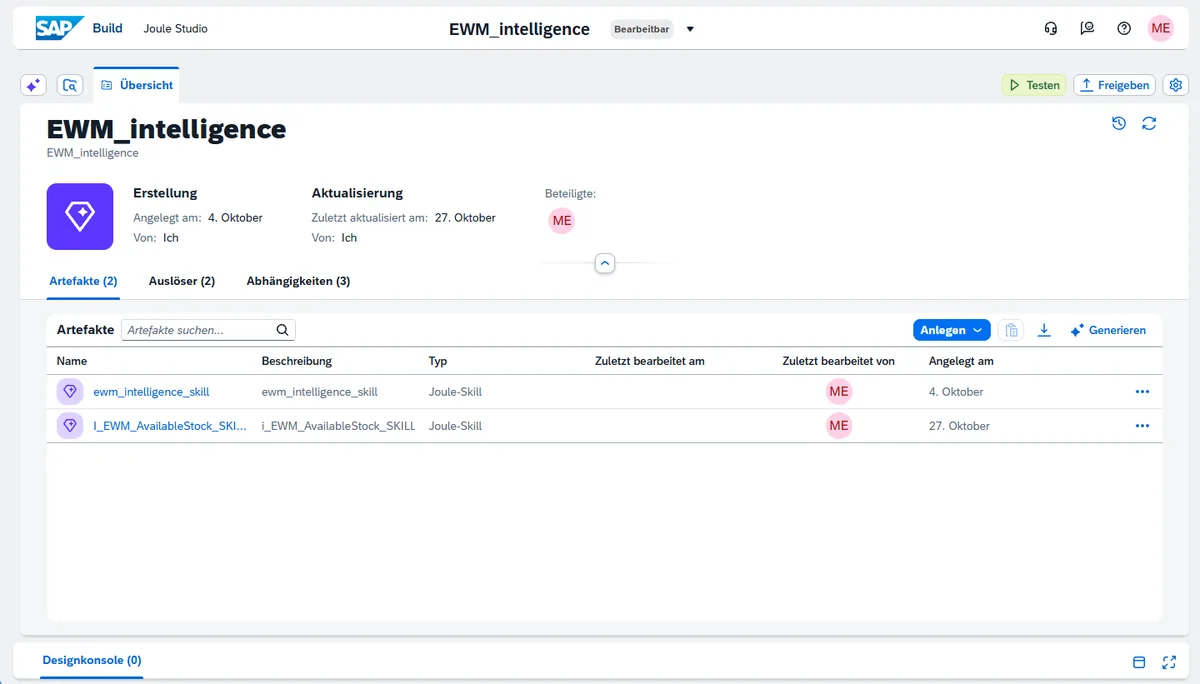
In Joule Studio, we first define which intent the skill should recognize and provide representative example phrasings for it. The more precise and varied these utterances are, the more reliably Joule later recognizes even differently worded versions of the same request.
- Defining the intent based on the previously prioritized skill gap
- Collecting realistic example phrasings from the relevant business area
- A first working version following a rapid-prototyping approach, testable early on
- Iterative refinement based on actual user phrasings
Action Integration
Where the Skill Actually Makes a Difference
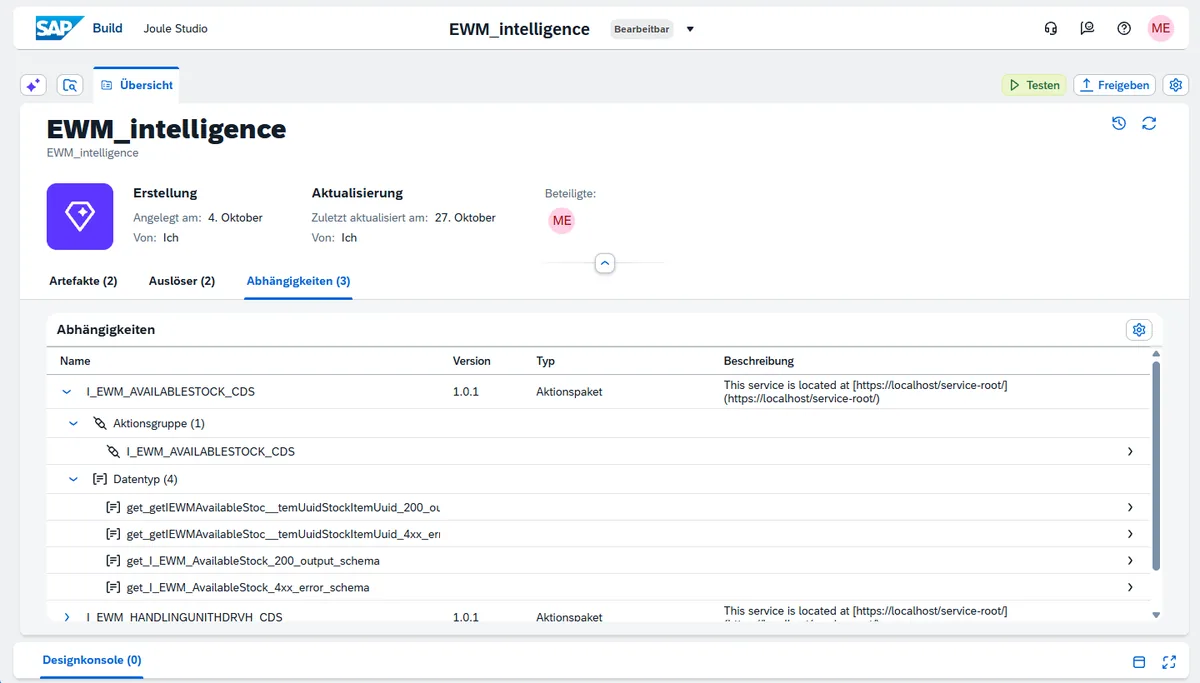
The recognized intent alone doesn't produce a response – only the action connects the skill to a CAP or RAP service or an external API and executes the actual query or action. For transactional skills with write access, we review authorizations and error handling with particular care.
- Connecting to existing CAP or RAP services instead of duplicating development effort
- Alternative integration of external APIs when no suitable SAP service exists
- Particularly close review for actions with write access to SAP data
- Defined error handling for when the called service doesn't respond
Test & Approval
Simulate First, Then Go Live
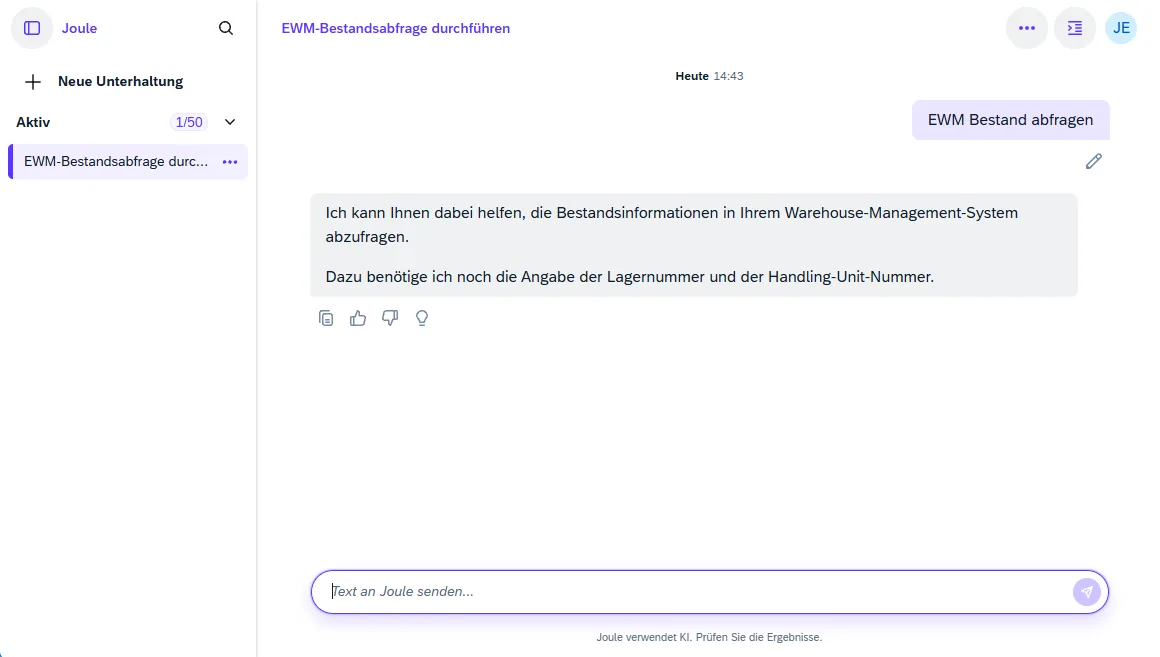
A skill that only covers the ideal case in testing causes frustration in production. In Joule Studio's test simulator, we check realistic phrasings, edge cases, and error paths before a skill moves into the production environment through the defined approval process.
- Simulated execution with realistic and atypical sample requests
- Checking error paths, such as missing authorizations or empty results
- Documented approval by a named responsible party before go-live
- Versioned transition from test to production instead of direct changes
Your Benefits
Why Custom Skills Are Worth It
Processes Without a Standard Skill Covered
Joule is extended for exactly the processes that SAP standard skills don't cover.
Reuse of Existing Services
Connecting to existing CAP/RAP services instead of duplicate parallel development.
Tested Before Go-Live
Simulating realistic and atypical requests before the production rollout.
Traceable Versions
Skill versions clearly separated across dev/test/prod instead of direct changes to production.
Authorization-Compliant
Particularly thorough review for transactional skills with write access.
SAP Standard-Compliant
Built exclusively through the intended Joule Studio mechanisms, without workarounds.
Rapid-Prototyping Approach
An early working skill draft instead of a months-long concept phase.
A Personal Point of Contact
An experienced team supports you from the first draft through to approval.
News, real-world insights, and perspectives from our SAP experts. (German-language articles)




Frequently Asked Questions
FAQ: SAP Joule Studio
The most important questions about building custom skills.
The SAP Joule Skills page covers selecting, prioritizing, and rolling out the skill catalog – in other words, which skills are needed in the first place. This page describes the technical implementation of a specific, already-prioritized custom skill in Joule Studio: from intent through action to testing and approval.
Not necessarily. SERKEM handles the development of custom skills either entirely or together with your team, depending on how much you want to take on yourselves going forward. However, for ongoing maintenance and expansion after the first skill, we recommend building up at least one internal contact person with a working knowledge of Joule Studio.
Yes, through transactional skills with write access. We deliberately treat these more strictly: tighter authorization checks, defined error handling, and typically an additional approval step before the production rollout – precisely because an action can't be undone the way a simple query can.
That depends heavily on whether a suitable CAP or RAP service already exists or still needs to be connected, and how complex the recognized intents are. Following a rapid-prototyping approach, a first working draft is available early on; the final effort estimate follows the functional specification.
A skill is tightly connected, via its action, to the underlying CAP or RAP service or API. If that interface changes, the action configuration must be updated accordingly. We recommend including custom skills in the same change-management process as the underlying services, so that such changes don't go unnoticed.
Where Standard Skills End, We Begin
Schedule a brief initial consultation: we'll review your specific skill requirement and show you what a first prototype in Joule Studio could look like.